Showing posts with label Wedding. Show all posts

Western European Wedding Traditions

Wednesday, April 6, 2011


Wedding traditions in Western Europe are as varied as the countries that make up the region – from Ireland to Italy, from Portugal to Switzerland and everything in between, the wonderful, colorful wedding traditions of Western Europe span almost a quarter of our world.

The engagement ring – one of the oldest of the Western European wedding traditions.

One of the ancient traditions of Western Europe which is still going strong today is the idea of the engagement ring. It was way back in 860 A.D. that Pope Nicholas I proclaimed that not only was an engagement ring required to seal the agreement to be married, but that the engagement ring must be made of gold. The making of the ring out of gold signified that the groom was willing to make a financial sacrifice for his new bride-to-be. 

It would be another 617 years before the tradition of adding a diamond to an engagement ring would be started. It was in the year 1477 that King Maximilian presented the lovely Mary of Burgundy with a diamond engagement ring, and from that day to this a diamond has been a girl’s best friend.
It was in Italy, the land of love, that gold wedding rings first became popular, and it was also in Italy that the tradition of the wedding cake was first begun when, in the first century B.C., a cake or bread was broken over the bride’s head to insure fertility.

The tradition of the Best Man began in medieval Germany.

It was in ancient Germany that the Western European tradition of a Best Man began. In olden days it was sometimes necessary for a man to kidnap his bride from a neighboring village and he needed his strongest friend (his Best Man) to help with the kidnapping and to stand by him at the wedding ceremony to fight off any relatives that might try to take her back.

Something old, something new, something borrowed, something blue.

But it was in England that many of our most enduring Western European wedding traditions got their beginning. The ancient nursery rhyme about something old, something new, something borrowed, something blue is now an important part of most Western European weddings, even though many brides and grooms no longer know the significance of the rhyme. 

Something old is symbolic of continuity. The old item was often a piece of lace or a grandmother’s scarf or an old piece of jewelry. Something new signifies hope for the future, and can be anything from a piece of clothing to the wedding band itself. Something borrowed is symbolic of future happiness and is often provided by a happily married friend of the bride. And finally, something blue. In ancient times blue was the color of purity and often both the bride and the groom wore a band of blue cloth around the bottom of their wedding attire. 

It was the knights of yore who gave us the Western European tradition of the groom wearing a single flower. It was customary for a knight to wear a flower or a colorful handkerchief belonging to their lady fair when they entered a tournament. The tradition later evolved to the groom wearing a flower from his bride’s wedding bouquet.

The white wedding gown was not a symbol of purity, but rather a symbol of joy.

What wedding today would be complete without the white wedding gown? Prior to the 16th century, however, this most important Western European Wedding tradition was not common. It wasn’t until Ann of Brittany popularized the white wedding dress in 1499 that the tradition became part of Western European wedding culture. 

During the Tudor period in England it became customary for the wedding party to throw old shoes at the bride and groom’s carriage; if the carriage was struck by a shoe it was considered a symbol of good fortune to follow. From this old Western European wedding custom was born the tradition of typing shoes to the back of the broom and bride’s car.

And finally it is time for the groom to carry his new bride across the threshold.

And finally, what wedding tradition would be complete with the groom carrying his new bride over the threshold of their home? This Western European tradition began with two beliefs. The first one was that if the bride were to trip or stumble as she entered her new home (as she crossed her new threshold for the first time) bad luck would plague the marriage. The second belief was that evil spirits inhabited the threshold of a new couple’s home and that if the bride stepped on the threshold the evil spirits would enter through her feet and the marriage would be doomed. 

The romantic answer, of course, was for the groom to carry his new bride across the threshold.
Western European wedding traditions have come down to us from many countries and many cultures to blend together seamlessly into the romantic wedding traditions that we know and cherish today.

Scandinavian Wedding Traditions

Traditionally Scandinavians don’t like to rush into marriage. Marriage is a serious business and in many parts of Scandinavia an engagement may last three or even four years, allowing plenty of time for the couple to get to know each other, to see each other at their best and at their worst.

The Gates of Honor

Many of the wedding traditions in the Scandinavian countries go back hundreds of years. In Denmark, for example, it is traditional for an arch of pine branches to be built in front of the bride’s home. This arch is known as the Gates of Honor.
At the wedding reception in Denmark it is traditional for the groom to disappear during part of the ceremony so that all the unmarried young men can kiss the bride – and then it is the bride’s turn to disappear while all the single girls kiss the groom.
To insure good luck and to ward off evil spirits it is required that a Danish couple cut their wedding cake together, the new husband and wife holding the knife together, and then for each wedding guest to eat a slice of cake.

Crowning the next bride-to-be

In Finland it is tradition for the bride-to-be to walk from house to house with a pillowcase to collect her wedding presents. While she walks from house to house an older, married man walks beside her, holding an umbrella or parasol over her head as a symbol of protection and shelter.
It is also traditional for a bride in Finland to wear a golden crown and during the wedding reception she is blindfolded and spun around while all the unmarried girls dance around her – the one she places the crown on will be the next to marry! 

Two pine trees – the symbol of fertility

When a couple is married in Norway their friends and neighbors plant two small pine tries on either side of their young couple’s front door as a symbol of fertility.
Also, a Norwegian bride wears a silver crown in silver charms hanging all around it. As she walks the charms tinkle, making a beautiful music sound which wards off evil spirits which love to cause havoc with newlyweds.

Gold and silver coins so the bride will never be without

In Sweden mother of the bride traditionally presents her daughter with a gold coin to be placed in her right shoe and her father gives her a silver coin for her left shoe. In this way they hope to ensure that their daughter will never be poor.
When a girl in Sweden is engaged it is customary for her to receive an engagement ring. Then, during the wedding ceremony the bride’s husband slips the wedding ring onto his new bride’s finger plus he slips a ring of motherhood onto her finger as well – meaning that a Swedish wife will wear three golden rings.
While the details may vary from one country to another, many customs and traditions are the same. Throughout all of Scandinavia there is some fertility custom that goes along with all marriage ceremonies, a recognition that the purpose of marriage is not to be a couple…but to become a family.

Middle Eastern Wedding Traditions

The Middle East contains some of the oldest civilizations on Earth, and so it is little wonder that many of their wedding traditions have been passed down for several centuries. While we must bear in mind that there are as many different traditions and customs as there are different peoples in the Middle East, it is also apparent that the region has a flavor that permeates all of the cultures of the region.

The engagement party is the first in a string of five wedding festive weddings celebrations.

In many parts of the Middle East it is common for five different parties to be thrown for the wedding ceremony. It starts with the engagement party. The bride and groom invite family and friends and a festive party is thrown, with special foods and much dancing and singing and happy music. Engagement parties can go on late into the night. During the party the bride often changes her dress up to five times.

The signing of the marriage contract is cause for even greater celebration.

The second party takes place on the day the bride and groom go to the courthouse and sign their marriage contract. Again family and friends are invited and there is much celebration, much music and dancing and song. Once again, it is customary for the bride to change her dress as often as five times during the party.

The Hena party is to ward off any evil spirits and to ensure the happiness of the new couple.

The third party takes place one day before the wedding and is second only in size to the party on the wedding day itself. This third party is named the Hena party. The word Hena might sound familiar; It’s a dye that is used to make special tattoos to the hands and feet of the bride, especially, to ward off evil spirits. This is also the party at which the “grinding” takes place. In many parts of the Middle East the bride and groom are seated while several unmarried girls hold a white cloth on their heads. The “grinding girl” then grinds together two lumps of sugar above the couples’ heads while asking God (Allah) to repel all evil spirits from the young couple’s life. It is traditional for the bride to wear a green dress at the Hena party and the party traditionally continues until dawn on the day of the wedding.

The wedding reception and the five almond pieces.

Following the wedding itself, at which the bride and groom exchange wedding rings – it is thought, by the way, that the wedding ring originated in the Middle East – there is the biggest party of them all. This wedding party is very similar to the receptions following U.S. and European weddings, with speeches, and much dancing and singing and traditional Middle Eastern music. Very often each guest is given five almond pieces, each almond piece symbolizing one of the five sacred wedding wishes: health, happiness, wealth, fertility and longevity.

The wedding shower.

The final party takes place 7 days after the marriage. In Arabic it is called Sabaa, which means Seven. In many ways the Sabaa party is equivalent to a wedding shower in the U.S. or Europe. The Sabaa is held at the home of the bride’s mother and only women attend. The bring the bride presents and the bride’s mother traditionally gives her daughter gold or diamonds.
While these customs – or slight variations of them – are common in many places in the Middle East, they are in no way universal. The Middle East is composed of many different cultures and each culture has its own rich and varied traditions. But one thing is universal in all Middle Eastern weddings, and that is the sense of joy and celebration that is universally expressed at the beginning of a young couple’s new life together.

African Wedding Traditions

Africa is a large and varied continent containing some of the oldest civilizations on earth. It is home to a wide diversity of religions and cultures, and this colorful diversity is reflected in its diverse and colorful weddings traditions. 

If any one wedding tradition might be said to be indicative of the African continent it would be the importance of family. An African wedding is, more than anything, the bringing together of two people as a single family, or the combining of two families or even the mixture of two tribes into one family unit. The concept of family is one of the unifying ideas of the African continent. 

There are more than 1,000 cultural units in Africa and each culture, each tribe has its own wedding and marriage traditions, many of which can trace their origins back hundreds or even thousands of years.
There are also many different religions represented in Africa. Many northern Africans, especially, have been influenced by Muslim traditions, while further south there are more Christian, Hindu, and even Jewish traditions interspersed with more ancient traditions. 

In many places in Africa young girls are trained to be good wives from an early age. They may even learn secret codes and secret languages that allow them to talk with other married women without their husbands understanding what is being said. 

Depending on which part of Africa you are in, wedding ceremonies can be extremely elaborate, some lasting many days. Often huge ceremonies are held during which many couples are united at the same time. 

In Sudan and in other areas along the Nile a man must pay his wife’s family in sheep or cattle for the loss of their daughter’s labor in support of the family. A wife may cost a man as many as 30 to 40 head of cattle. Often it is difficult to pay the family yet still have enough cattle left to support his new wife.
In Somalia a man is allowed to have as many as four wives if he can support them all, and it is not uncommon for a girl to be engaged before she is even born. 

Bright festive colors, song, dance, and music are vital elements of many African wedding ceremonies. Common to all wedding ceremonies is the concept of transitioning between childhood and adulthood. In many African cultures children are encouraged to marry as young as 13 to 15 years of age, as soon as they have reached physical adulthood. 

Divorce is rare in African marriages. Problems in a marriage are often discussed with both families and solutions found. Often entire villages join in to help a couple find solutions to their problems and keep a marriage from failing. 

Marriage is sacred the world over, and that is definitely true in Africa, no matter which region or which culture you come from, and no matter what your religious beliefs. In fact, many cultures have a special totem that is designed to remind a couple that cultural and tribal differences must be allowed for in order to make a marriage succeed.

Korean Wedding Traditions

Family Wedding Traditions
 
Before a Korean bride may be married, she must take part in the traditional Introduction ceremony, where she is accepted into the groom's family.
After the Korean newlyweds have exchanged their wedding vows, the groom, formally, introduces his new wife to his parents. The groom's father may throw red dates at his daughter-in-law to bring her luck in fertility.

Important Korean Symbols
A couple getting married in Korea might incorporate ducks or geese into their wedding ceremony. Both ducks and geese mate for life and represent faithfulness.
At one time, a man who wanted to get married in Korea, would travel to his future bride's home on a white pony and present her family with a pair of geese.

World Wedding Traditions

Bridal Customs in different Countries

The word “wed” is derived from the ancient Greek word for “pledge.” And that’s exactly what a wedding is, no matter what country it takes place in, no matter what culture it’s part of. To wed is to pledge yourself to another. There are few acts we perform that are more pure or more beautiful than the act of marriage.

The pledge that lasts a lifetime

Marriage is the most solemn pledge we make in our lifetimes. Traditionally the wedding pledge is made in front of family and friends who take special pains to stand up and witness our pledge. The wedding pledge is to be true and faithful and loving to another human being. To wed is both the most basic of all human pledges, and at the same time the most sublime.
Marriage carries with it the most solemn of promises, but it also embodies the potential for the greatest joy of human existence – the pure joy that flows from two hearts beating as one. There are few joys in life as deep or as long lasting as the joy that springs from the well of true love and a lasting marriage.

Kiss

We even have a term for it: soul mates. Two people, individual but at the same time inextricably a part of each other, so in-tune with the wants and the needs and the desires of the other that often words are not necessary. A mere glance between two lovers speaks volumes.
In almost all cultures the marriage ceremony ends with the bride and groom exchanging a kiss. The wedding kiss transcends cultures, it bridges tribes, it is one of the very few things that bind all of us together as human beings. From ancient times to the modern day, from the deepest jungles to the tallest skyscrapers, the wedding kiss symbolizes for all people everywhere the physical uniting of two souls.

Tie the knot

It has often been said that love transcends everything, that it knows no barriers. If you are looking for a unique or thoughtful way of showing your love, then perhaps you have come to the right place. Here you will find many ways to “tie the knot.” Perhaps you will discover a charming wedding tradition that you can make all your own. If you have decided to make the pledge, then be prepared to embrace love and marriage in all its splendors, and the world will be yours.

Japanese Wedding Traditions

Getting Married in a Japanese Shinto Shrine
Historically, Japanese wedding ceremonies were performed in Shinto Shrines. Many of Japan's wedding sites, therefore, provide shrines for couples who want to follow Japanese wedding traditions. 

Japanese Wedding Day
The Japanese bride-to-be is painted pure white from head to toe, visibly declaring her maiden status to the gods. The bride wears a white kimono and an elaborate headpiece covered with many ornaments to invite good luck to the happy couple. A white hood is attached to the kimono, which the bride wears like a veil to hide her 'horns of jealousy' from the groom's mother, who will now become the head of the family. Japanese grooms wear black kimonos to their wedding ceremony. 

While the bride and groom exchange their wedding vows, their families face each other, instead of the couple getting married. Central to the traditional Japanese marriage ceremony is the ritual of drinking nine cups of sake, after which newlyweds are considered united. Families and guests also drink sake, to symbolize the bonding of the couple as well as of the two families. The father of the groom, and of the bride, then introduce their respective family members. 

Japanese Reception Celebration
For the wedding reception, the new bride changes into a red kimono and again later into a western-style gown. The wedding party and invited guests engage in games, skits and karaoke during the wedding reception. Guests are expected to offer the couple goshugi -- money -- in a festive envelope either before or after the wedding ceremony.
Due to better climate, many Japanese brides prefer spring and fall wedding dates. Certain wedding anniversaries are thought to be lucky, so it is common to see dozens of newlywed couples heading for their honeymoon on the same day.

Bride returning home - 三朝回門 San Chao Hui Men

Traditionally, three days after the wedding, the bride will return home to her family to be considered as a guest. The bride cannot stay overnight. The bride will bring along a pair of roasted pig, two boxes of cakes, two bottle of wine, two candles, two chicken, shen cai, and gifts for the family. The groom may or may not accompany the bride. The bride’s family will return parts of the gifts as a courtesy.

In modern day, the bride will still return home on the 3rd day. However, now-a-days the bride may or may not need to bring back any gifts for the family. Often, they may away on their honeymoon overseas.

These are the most of common wedding practises. How much is followed today really depends on the various Chinese families and dialect groups. It is quite common for most Chinese modern weddings to retain only the tea ceremony and wedding banquet. Hope you find some of the information under this article useful to you or your family, friends who will be preparing their wedding!

Wedding Banquet - 结婚宴席 Jie Hun Yan Xi

Traditionally, to celebrate the marriage, the groom’s family will throw a wedding feast for their respective friends and families. The bride’s family may also throw their own wedding feast separate from the groom. How grand or large depends on how much they can afford. There can be a single feast or a many feast up-to 7 days if necessary. However, most will hold only one single feasts. If multiple feasts are held, the wedding feasts held on the actual day of the wedding that is most important. And that would be the day where friends & relatives will witness the union of the couple.

In modern day, a wedding ceremony is held at restaurant or hotel usually on the same day as the tea ceremony in the evening to witness the union of the couples. Usually, a list will be prepared for all the guests that will be attending, and the various family members will be assigned to the first few tables for each side of the family, followed by the friends.

Related : Traditional Chinese Wedding Procedures
Prev << Wedding & Tea Ceremony - 拜堂 Bai Tang /奉茶 Feng Cha 
Next >> Bride returning home - 三朝回門 San Chao Hui Men

Wedding & Tea Ceremony - 拜堂 Bai Tang /奉茶 Feng Cha

After the bride arrived at the groom’s house, the couple will pay homage (respect) to the heaven and earth. They will then worship the ancestors. And the bride and groom will also bow to each other.

Finally, tea with two lotus seeds or red dates will be offered to groom’s parents. After which, they will serve tea to the other relatives of the groom’s family according to the seniority. The more senior/elderly relatives who are served tea will present the groom & bride with red packets or a bridal jewelry. The younger relatives/children that are younger than the bride & groom, will in turn serve tea to the bride & groom and receive a red packet. This is generally practiced in both traditional and modern tea
ceremony.

Related : Traditional Chinese Wedding Procedures
Prev << Arrival at the Groom’s House - 过门 Guo Men 
Next >> Wedding Banquet - 结婚宴席 Jie Hun Yan Xi

Arrival at the Groom’s House - 过门 Guo Men

In the past, once the procession reached the groom’s house, firecrackers will be set-off to frighten away evil spirits again. And a red mat/carpet was placed before the sedan chair for the bride to dismount. The bride was required to step over a lit charcoal stove before entering the house. However, avoid having her clothing catch fire! The act of stepping over fire is meant to “cleanse” her which literally means to
burn away evil influence and ward-off back-luck.

Like the western counter-part, after the rituals are completed, the groom could finally raise the red scarf to view the bride’s face for the tea ceremony.

In modern day, especially the Cantonese dialect group may still practise crossing over the lighted charcoal stove. Nowadays, the red umbrella may still be used to usher the bride from the car to the house.

Related : Traditional Chinese Wedding Procedures
Prev << Before Bride leaves the House - 出門 Chu Men
Next >> Wedding & Tea Ceremony at the Groom’s House - 拜堂 Bai Tang /奉茶Feng Cha)

Bride leaves the House - 出門 Chu Men

Traditionally, when the groom arrives at the bride’s house, a woman that has enjoyed relatively good luck (大妗姐da jin jie) may be employed to escort/carry the bride on her back into the sedan chair/carriage. It is said that the bride’s feet cannot touch the ground until she arrived at the groom’s house.

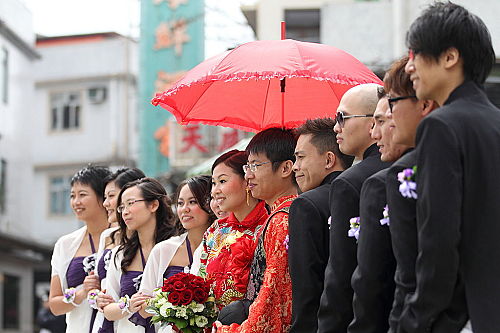
The bride’s maid (伴娘must be unwed girl) assigned to hold a red umbrella to shield the bride from the sun/ sky light, to symbolize bringing lots of children to the groom’s family. A third assistant may be engaged to sprinkle rice on sedan chair to prevent chickens from pecking the bride. Before the bride sits on the bridal sedan, she must thank her relatives sending her off by bowing to them.

Firecrackers may also be lighted and set-off to scare evil spirits while, the bride leaves her family's home. Those who are considered to have incompatible horoscopes are not allowed to accompany the bride to the groom's home.

In modern day, after the groom has pick up the bride and is ready to leave. An assistant (e.g. Bride's maid) not necessary that of a lady of good fortune, will use the red umbrella to usher the bride into the wedding car. This red umbrella is passed on to the groom’s car for the groom’s side to usher the bride out of the car when they reach the groom’s house. Many modern families nowadays may skip this red umbrella or rice throwing.

Related : Traditional Chinese Wedding Procedures
Prev << Groom fetching Bride - 迎亲日 Ying Qing Ri 
Next >> Arrival at the Groom’s House - 过门 Guo Men

Groom fetching Bride - 迎亲日 Ying Qing Ri

Traditionally, groom will send a bridal sedan chair/bridal carriage to pick up the bride. A procession of musicians to play wedding music all the way and gifts will also be brought to the bride’s family. The procession may be also accompanied by a male child/or a group of children to signify future sons. In many instances a lion dance procession and attendants with lanterns and banners will accompany the procession.

In modern day, the groom will prepare a wedding car to pick up the bride. The groom and groomsman will decorate the car before it is ready for use. When the car arrives, a male child will be assigned to open the door for the groom to come down. And before the groom actually can enter the house, he will be blocked by the bride’s family or friends who will not surrender the bride so – fast!. Often, offers of red packet and a series of tasks/questions have to be fulfilled to the bride’s friends before he is allowed to enter the house to fetch the bride.

In some cases, the groom will be invited to have some food (snacks) with the bride’s family. Sometimes, he may be offered a pair of chopsticks and two wind goblets wrapped in red paper. Some grooms may also be offered sweet longan tea, two hard-boiled eggs and transparent noodles. These are to symbolize that the groom is happy and contented to receive the bride.

Some groom may also have to drink a soup of soft-boiled eggs, where the groom is supposed to break the yolk. This is symbolic of the bride having to break her ties with her family.

For many modern Chinese, the couple may hold the tea ceremony for the bride’s family. The bride’s parents will be served first followed by other relatives. Just as in the tea ceremony at groom’s house which I have described next.

Related : Traditional Chinese Wedding Procedures
Prev << Combing of the Bride’s Hair - 上头 Shang Tou
Next >> Before Bride leaves the House - 出門 Chu Men

Combing of the Bride’s Hair - 上头 Shang Tou

Traditionally, for some Chinese dialect group, at the dawn of the wedding day or the night before the wedding, the bride will be bathed in water added with pamelo, lime leaves etc to cleanse the body. She will put on new clothes. Then she will sit before a set of long-feng (dragon and phoenix) candles to have her hair combed. A woman that has enjoyed reasonable good fortune in life; will help comb her hair. The act of combing the bride's hair is to symbolize a long and lasting marriage. As she comb the hair she will usually say the following:-

一   梳,  梳   到   尾
yì shū shū dào wěi
1st combing represents: from start of marriage until the end

二  梳,  梳  到  白  髮  齊  眉
èr shū shū dào bái fà qí méi
2nd combing represents: harmonious relationship until old age

三  梳,   梳   到   兒   孫   滿   地
sān shū shū dào ér sūn mǎn dì
3rd combing represents: will have many sons and grandsons everywhere

四   梳,   梳  到  四  條  銀  筍  盡  標  齊
sì shū shū dào sì tiáo yín sǔn jìn biāo qí
4th combing represents: monetary wealth and for a long and lasting marriage.

Traditionally, the bride and groom will be wearing red. And on the wedding day, the bride will also be covered with a red silk veil or a curtain of beads hung from the bridal crown.

In the very old days, the groom also have a similar hair combing procedure, but this is no longer practiced anymore.


In our modern day practice, many brides follow the western tradition of wearing white (symbolizing purity) usually for photo taking and almost the entire day. However, for some, who may hold an evening wedding, the bride may first wear her white wedding dress and mid-way during the dinner, change to a “lovely” red dress. This really depends on the individual family.

Related : Traditional Chinese Wedding Procedures
Prev << Sending Formal Gifts - 过大礼 Guo Da Li
Next >> Groom fetching Bride - 迎亲日 Ying Qing Ri

Setting up the Bridal Bed - 压床 An Chuan

Traditionally, a good/auspicious date is selected to move the bridal bed into the right place. Here, usually a man that has good or reasonable fortune (health and money) will help to setup/position the bridal bed. Afterwards, the bed will be left untouched until the day of the wedding. This procedure is often or usually done a few weeks before the actual wedding date.

After the bed has been moved to it's right place, a MALE healthy child e.g. relative's son will be invited to lie and roll over the bed to signify fertility and the hope that the couple will have a MALE son.

Red beans/green beans, lychee, dates, peanuts, oranges and other fruits are often scattered onto the bed. Usually, the types of offerings depends on the season and varies from different regions and dialect groups.

This practiced is still done during modern times. The only difference is that this
procedure is done sometimes even on the eve or day before the wedding or on the same day of the sending the formal gifts (过大礼Guo Da Li) or even a few weeks prior to Guo Da Li. Nowadays, so long as this is done, there is no issue as to doing it on a specific date.

Prev << Traditional Chinese Wedding Procedures
Next >> Sending Formal Gifts - 过大礼 Guo Da Li

Traditional Chinese Wedding Procedures

In the past, the prospective bridegroom's side would sent letters to the family of the bride.
There were a total of Three (3) letters 三书(san shu):-

1. Initial gifts were presented together with a letter requesting for a marriage.
2. If the bride side agreed with the wedding: Formal gifts were given to the bride's
family together with a letter listing out all the formal gifts.
3. On the day of the wedding, a wedding letter was presented to the bride's family
to show that the bride has become a member of the groom's family.

In addition, it is common to observe 6 steps 六礼(liu li) or etiquettes leading towards the
actual wedding process:-

1. Getting a match-maker to convey the groom's family request to the bride's side.
2. Exchanging both bride & groom's date of birth to check on their compatibility.
3. If all goes well and both parties are happy with the arrangement, the groom's
side would sent an initial gift together with a letter requesting for the marriage.
4. If the bride's family accepts the wedding proposal, the formal gift (Guo Da Li) will
be sent by the groom to confirm the acceptance of the marriage.
5. An auspicious date is selected for the wedding.
6. The day of the traditional wedding ceremony.

Now-a-days in a modern wedding, most Chinese families no longer adhere to the sending
of the above Three (3) letters. Furthermore, not all the six-steps or etiquettes may be
followed:-

1. More often, couples know each other through schooling, work-place or other
social gatherings. Less dependent on family match-makers. Although other type
of match-making is becoming popular e.g. SDU, internet match-making
websites.
2. Some modern families e.g Chinese Christians have done away with the
checking and exchanging of the Bride & Groom’s date of birth-dates. They may
also turn to a geomancer to look at favourable dates.
3. Nowadays, if both parties (brides & groom's) are agreeable with the wedding,
they may have a formal meeting to discuss on what type of formal gifts the
bride's side would like to have and also to discuss the amount of wedding tables
that will be allocated by the groom's side to the bride's family side. For example
the bride's side may request for 40 wedding tables for the bride's family. Some
bride's family may even “chip-in” or may not even want to burden the groom's
side with added finances. It all depends!
4. More or less auspicious date is selected for the wedding.
5. Nowadays, there is the formal wedding at the Registry of Marriage for many
Chinese followed by the Traditional Wedding Ceremony or for Christians or
Catholics, a formal wedding at a church.

Next >> Setting up the Bridal Bed - 压床 An Chuan

 
Copyright 2005-2011 Sweetest Moments Pte Ltd. All rights reserved.